
Wyandot Projected Versus Actual Release
A projected release date looks forward. An actual release date records a completed custody event. The distinction is vital in Wyandot County because three systems can be involved: the Wyandot County Jail, the Ohio Department of Rehabilitation and Correction, and the sentencing court. A court order can authorize release before jail staff complete identification, property, paperwork, hold checks, or transfer steps. Likewise, an ODRC date field may signal a projected prison release or parole eligibility rather than a guaranteed departure.
Pretrial detainees usually do not have a sentence-based end date. Their release depends on bond, dismissal, a judicial order, case resolution, or another legal event. A sentenced county jail detainee has a term set by the court, but jail-time credit and other cases or holds can affect the practical end. A state prisoner has sentence calculations maintained by ODRC. These paths cannot be combined into one formula.
| Record | What it can establish | What it cannot establish alone |
|---|---|---|
| Court sentencing entry | Term, legal order, and credited time stated by the court | The exact hour physical release processing ended |
| ODRC individual detail | Current state status, sentence context, and expected release or parole eligibility field | A promise that release will occur on that date |
| Wyandot jail register | Historic date and manner of discharge after it occurs | A future state-prison release calculation |
| VINE event | A custody event reported by a participating agency | Destination or proof that every other hold ended |
Search Wyandot Projected Release Dates
Start with the current custodian. If the person is in an ODRC institution, the ODRC Offender Search is the public state route. It accepts a last name, first and last name, or offender number. Filters include status, county of commitment, residential county, ZIP, and next Parole Board hearing month. County of commitment can connect a state record to a Wyandot sentence, but it is not proof that the person is housed in the county.
- Determine whether the person is awaiting trial, serving a Wyandot jail sentence, or serving an Ohio prison term.
- For state prison, search ODRC and compare the offender number, birth information, county, docket, offense, and sentence before choosing a result.
- Read current status first. Then locate Expected Release Date/Parole Eligibility Date, aggregate sentence, jail-time credit, offense information, and parole or release detail.
- For a county jail term, obtain the filed sentencing entry from the Municipal Court search or Common Pleas search. Ask the jail about its calculation and any holds.
- For a completed Wyandot jail stay, request the jail-register entry showing date and manner of discharge under R.C. 341.02.
- If the public state detail conflicts with a court record, contact ODRC Central Records for the underlying state information.
The ODRC individual record view demonstrates where the combined expected-release and parole-eligibility label appears. The image is an example of the field layout, not a basis for republishing a person's profile.
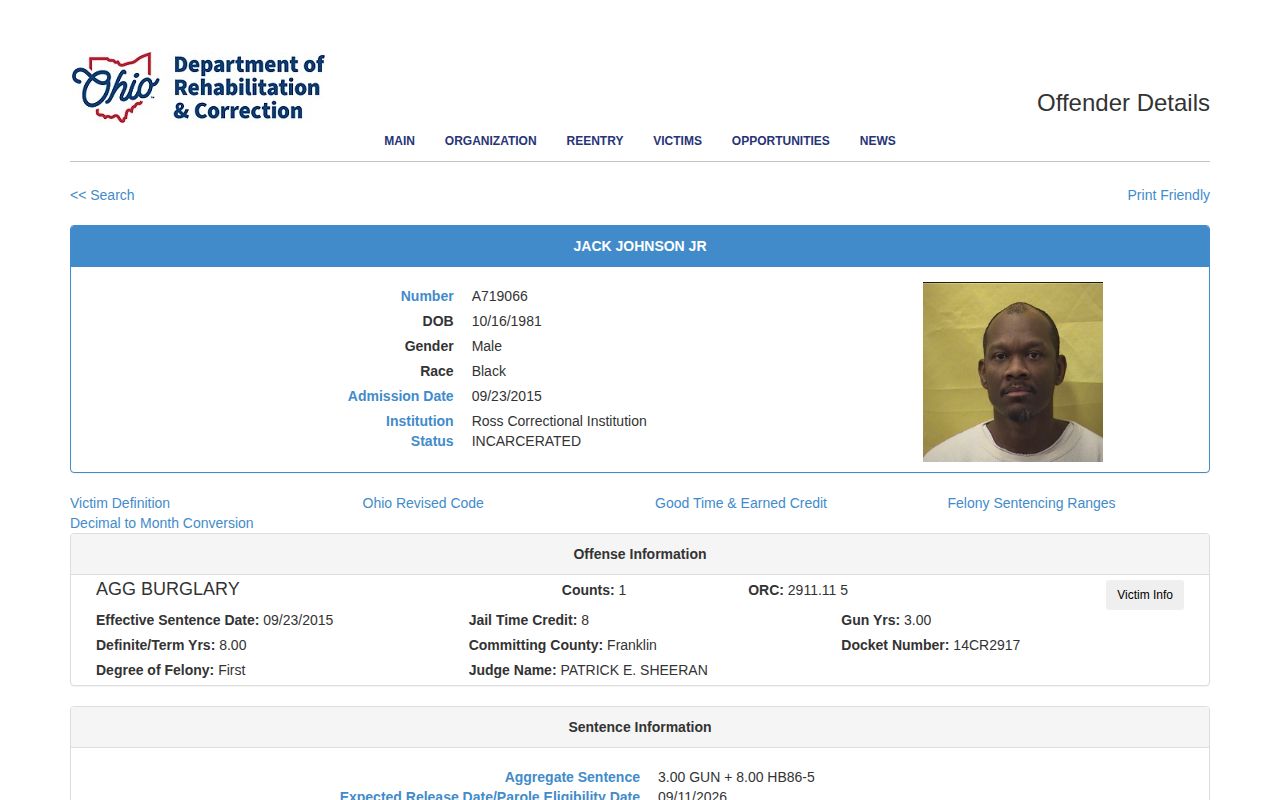
The record must be read as a whole. Status and sentence context control whether the displayed date concerns expected release, parole consideration, or a sentence-related field on a person already released.
Note: A future-looking ODRC date does not override a current status that already says Released or APA Supervision.
Wyandot ODRC Release Date Fields
ODRC defines Expected Release Date/Parole Eligibility Date as a combined field. It can be the projected release date or the date when the person is pending parole consideration. That slash joins two different legal ideas. An expected release date is a sentence calculation. Parole eligibility is the point at which an eligible person may be considered by the Ohio Parole Board. Eligibility is not a grant of parole.
Read the combined date with current status, aggregate sentence, effective sentence date, jail-time credit, offense counts, parole detail, and the latest hearing result. An incarcerated status places the field in a future custody context. APA Supervision means prison custody has ended and state supervision has begun. Released may include a more specific descriptor such as judicial release. A sentence detail that remains on screen after release does not return the person to custody.
The ODRC detail is a public status tool, not always a certified sentence computation. ODRC warns that sentence information may be incomplete. Questions about an exact calculation or conflict go to Ohio Department of Rehabilitation and Correction, Attn: Central Records, P.O. Box 430, Columbus, OH 43216. The filed Wyandot Common Pleas judgment remains important for the court-imposed term and jail-time credit.
Ohio Credits Affecting Wyandot Releases
Ohio does not apply one universal rule that every state prisoner serves exactly 85 percent. R.C. 2967.194 establishes productive-participation and program-completion credits for eligible people during its stated period beginning April 4, 2024. A qualifying person may provisionally earn one or five days for a completed month of participation. Up to five more days can follow completion of a second qualifying program or activity. Certain qualifying completions can yield 90 days or ten percent of the stated term, whichever is less.
Subject to the statute and its exclusions, ordinary aggregate participation and completion credit is capped at 15 percent of the stated term. The common 85 percent phrase is only the arithmetic complement of that cap. It is not a freestanding sentence calculator. Some people qualify for less credit or none. Mandatory or nonreducible terms, murder-related sentences, life without parole, R.C. 2971.03 sentences, certain sex offenses, and other listed classes have exclusions or distinct rules.
The official current earned-credit statute shows why eligibility and exclusions must be checked in the live law. Older snippets may describe a prior framework.
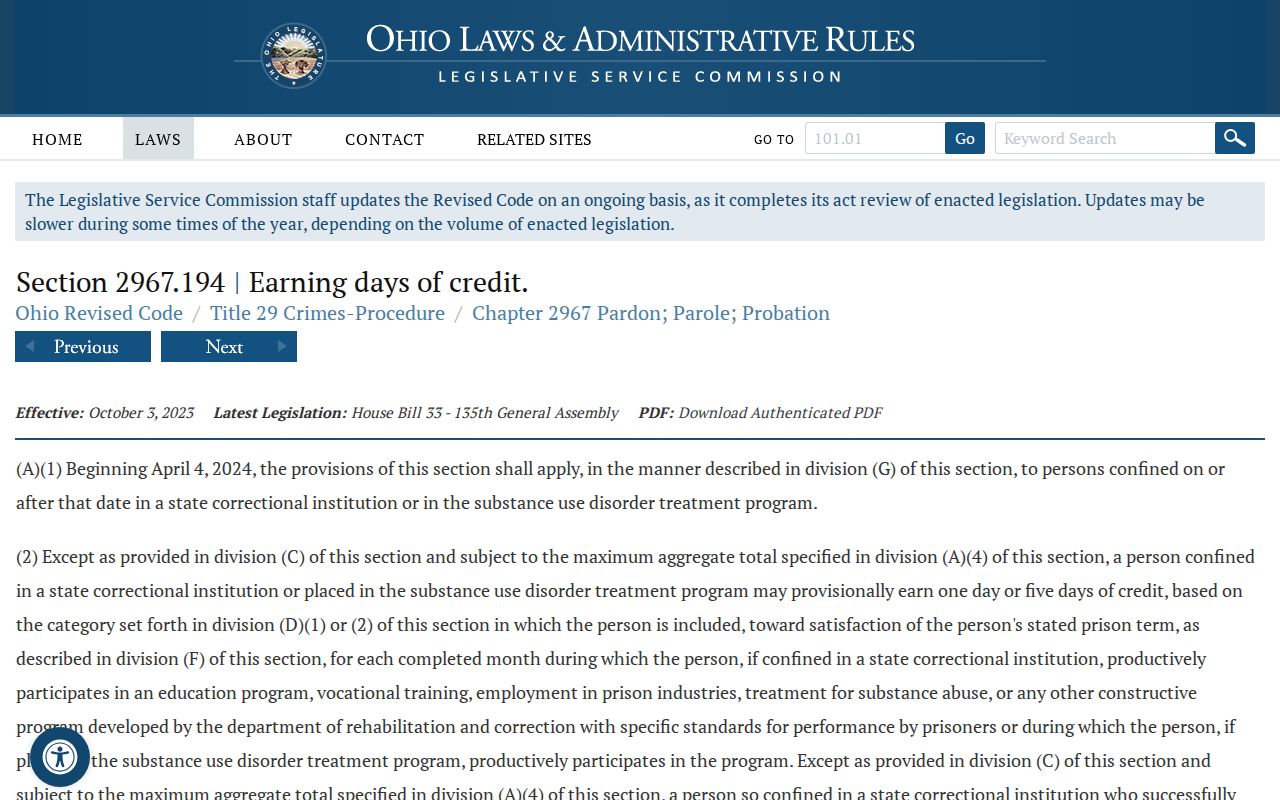
The statute supplies rules and limits. ODRC applies them to an individual state sentence; a reader should not turn the page into a personal calculator.
R.C. 2967.193 addresses qualifying earlier confinement through the transition in R.C. 2967.194(G). R.C. 2967.191 separately governs qualifying jail-time credit toward a prison term. For certain Reagan Tokes indefinite sentences, R.C. 2967.271 uses presumptive-release, minimum, and maximum concepts with statutory proceedings. None supports one quick percentage for all Wyandot cases.
Note: The 15 percent cap describes eligible state credit categories, not a universal promise of an 85 percent sentence.
Why Wyandot Release Dates Change
A date can move for lawful reasons after it first appears. Credit may be earned, denied, or lost within the governing process. A court can correct or modify a sentence. The Parole Board can act on an eligible case, and its rules permit certain projected dates to be rescinded. Another agency's detainer can prevent community release even though the first custodian's term or authority ends.
| Factor | Possible effect | Best confirmation source |
|---|---|---|
| Earned or program credit | May reduce an eligible ODRC term within statutory limits | Current ODRC calculation and R.C. 2967.194 |
| Discipline or credit decision | Can alter credit used in the projected calculation | ODRC record or underlying decision |
| Sentence correction | Can change the term, jail-time credit, or aggregate calculation | Filed court entry and ODRC Central Records |
| Parole Board action | Can grant, continue, defer, or rescind a projected outcome under its authority | Individual result and official decision record |
| Detainer or another case | Can lead to transfer or continued custody elsewhere | Jail discharge manner and receiving agency |
| Legal change | Can alter the governing rule or calculation | Current statute and agency record |
O.A.C. 5120:1-1-10 permits the Parole Board to establish a projected release date within the rule and allows rescission. Specified life and Chapter 2907 cases receive special treatment. For parole-eligible sentences, R.C. 2967.13 uses offense and sentence-specific rules. These records explain why a hearing date, parole eligibility date, and projected release date should not be used as synonyms.
Wyandot Jail Release Date Math
No official Wyandot County good-time formula, fixed release hour, or weekend and holiday advancement rule was located. That absence is the county-specific limit. Do not import ODRC's state-prison credit rules into a Wyandot County Jail sentence. Do not assume that a Sunday release shifts to Friday. The local calculation begins with the court's sentencing entry and qualifying jail-time credit, then requires a check for other cases, warrants, detainers, or transfer orders.
The Upper Sandusky Municipal Court handles countywide misdemeanor matters and felony preliminary stages. Wyandot County Common Pleas handles felony disposition and sentencing. Either docket may show the legal term, but neither proves the hour jail processing ended. The Sheriff's Corrections page routes case-status questions to the courts, reinforcing this split between court authority and physical custody.
A useful local check keeps the case sequence intact. Start with the judgment date, stated term, and the court's credited days. Next, ask whether another Wyandot case or an outside agency has placed a hold. Then ask the jail whether its own calculation matches the court record. A court-authorized end to one sentence does not cancel another valid source of custody. If jail staff report a transfer, record the receiving agency and move to that system. This method does not manufacture a projected day. It identifies each part of the calculation and leaves the final custody decision with the agencies that maintain it.
After release, R.C. 341.02 supplies the durable historic route: request the jail-register entry for the name, commitment date and cause, and date and manner of discharge. That discharge record can show whether the local term ended in community release or transfer. It is more reliable than reverse-engineering a past date from a sentence.
Note: Wyandot County publishes no local rule supporting a fixed release hour, automatic weekend change, or county earned-time percentage.
Confirm Wyandot Projected Release Events
Recheck close to the date. For an Ohio prison case, compare the live ODRC status and individual detail with the court record. For a Wyandot jail sentence, contact the jail and request the completed discharge entry once processing occurs. If the release becomes a transfer, use the receiving system rather than describing the person as released to the community.
Ohio VINE adds event notification for a specific person in participating county jail or ODRC custody. Registration can provide notice of release, transfer, or other custody change, but the agency's event label controls the meaning. The Wyandot VINELink inmate search instructions explain how to register and acknowledge a phone alert. VINE can lag and does not cover federal BOP custody, so confirm the alert with the source agency.
Record the date accessed, current status, reporting agency, and exact event wording. That short audit trail helps resolve later changes. A sound conclusion is narrow: projected by ODRC, eligible for parole consideration, authorized by the court, discharged by the jail, or reported released by VINE. Each phrase identifies what the source actually proves.